Types of Fermented Tofu: A Shopper's Guide to Fu Ru
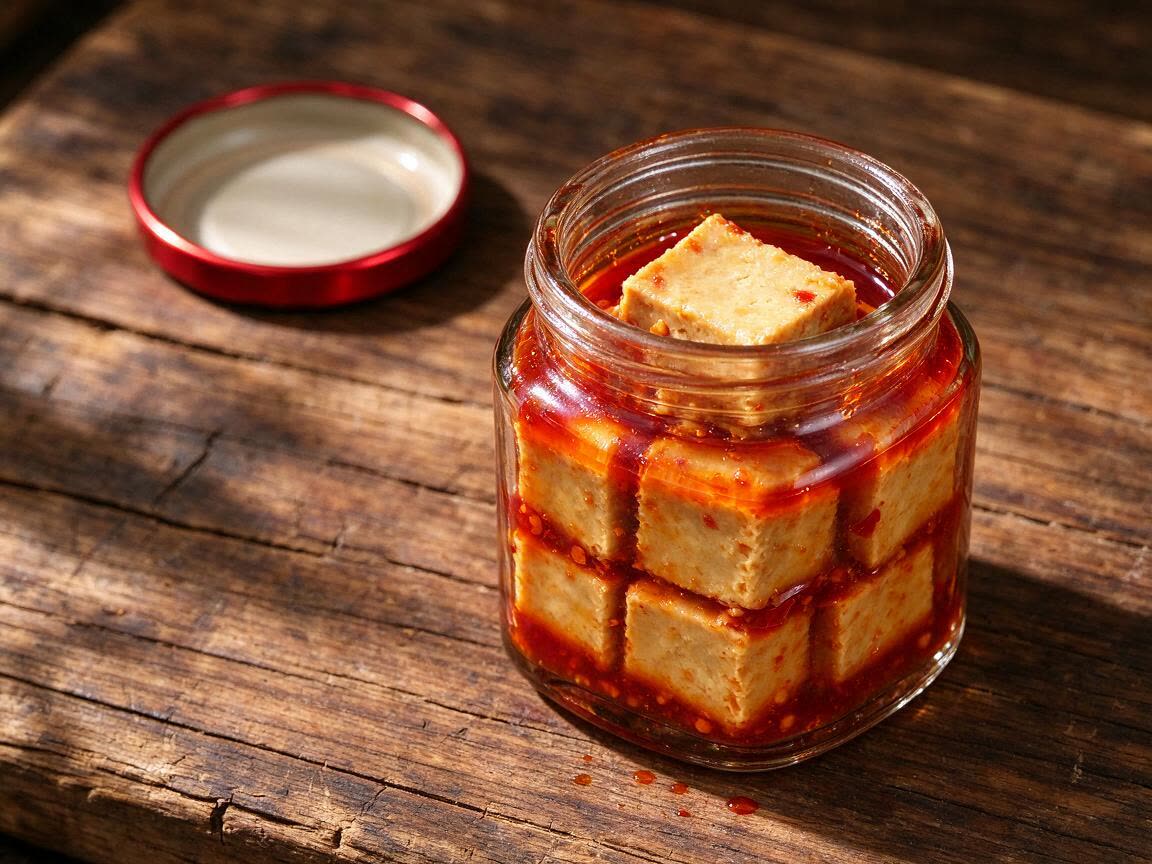
White, red, or chilli-flecked: what the $2.50 to $6 jars of fermented tofu actually taste like, how they differ, and how to cook with each one.
A jar of fermented tofu runs $2.50 to $6 at a Chinese grocer and keeps for a year in the fridge. The mistake most people make is buying one jar, deciding they don't like it, and giving up. Fu ru is not one ingredient. It is a family of them, and white and red versions taste about as alike as mozzarella and aged parmesan.
Here is what people actually ask me about it.
What is fermented tofu, exactly?
It is tofu that has been pressed firm and drained, cut into cubes, inoculated with a mould culture (usually Actinomucor elegans), left to grow a white fuzz, then packed in brine with salt and rice wine to age. The mould breaks the protein down, which is why the finished cube is creamy rather than rubbery and why the brine tastes like a savoury, fermented sherry. Chinese sources have described the process since at least the Ming dynasty; it is a preservation method, not a health food.
You will see it sold as fu ru, furu, tofu cheese, or preserved bean curd. The cubes come in glass jars submerged in liquid. Never buy a jar with a dry top layer or a lid that hisses.
A good cube holds its shape when you lift it with chopsticks but smears like cold butter when pressed. That texture is the whole point. If the cubes have gone to mush in the jar, the batch was likely pasteurised too hard or has sat too long, and the flavour will be flat and sour rather than deep.
White versus red: which one do I want?
White fu ru (bai fu ru) is the plainest. Cubes are pale cream, the brine is light, and the flavour is salty, faintly funky, and close to a soft ripened cheese. This is the one to eat straight, spread on congee or steamed buns, or stirred into a dipping sauce.
Red fu ru (hong fu ru) is coloured with red yeast rice, which gives it a deep brick tint and a rounder, sweeter, more savoury taste. It is the standard for braised dishes and marinades. A spoonful mashed into a braise of pork belly or winter melon does more than salt alone.
There are also chilli versions, sesame versions, and a strong-smelling fermented variety (chou doufu's cousin) that most beginners should skip. Some jars are sold as jiang doufu, a soy-sauce-browned style common in the north; it sits between white and red, saltier and darker, good in noodle broths.
One tell in the shop: shake the jar gently. A healthy white or red fu ru barely moves; the brine is thick from dissolved protein. A jar that sloshes like water is usually a cheap, fast-fermented product.
How much do I use, and how do I store it?
One cube is roughly a teaspoon of paste once mashed, and it is salty. Treat it like anchovy paste: start with one cube per pound of meat or per quart of braising liquid, taste, then add. Two cubes will overpower a stir-fry for two people.
Keep the jar in the fridge, cubes fully submerged. Use a clean chopstick or spoon each time; a wet, foody utensil is how jars go off. If the brine drops below the cubes, top it with a splash of shaoxing wine and a pinch of salt. It will keep six months to a year. A white film on the surface is normal; green or black fuzz is not.
What goes wrong: leaving the jar on the counter for a week. The cubes soften, the brine turns sharp, and the smell moves from cheesy to sour. You will notice because the lid smells like old socks when you open it. Throw that jar out; do not try to rescue it with more wine.
Can I substitute it, and what substitutes for it?
For white fu ru in a sauce or on rice: equal parts white miso and a splash of dry sherry, roughly 1 tsp miso plus 1/4 tsp sherry per cube. It gets you the salt and the fermented depth but not the creaminess.
For red fu ru in a braise: 1 tbsp white miso plus 1/2 tsp dark soy sauce plus a pinch of sugar per cube. The colour will be browner, not red, but the savoury backbone holds.
Do not substitute plain tofu. It has none of the salt or the fermented flavour, and the dish will taste flat.
Which brands are worth buying?
At a Chinese grocer, look for jars with visible, intact cubes and a brine that is cloudy but not murky. Koon Chun and Pearl River Bridge are widely available and consistent. Lao Gan Ma makes a chilli-fermented tofu that is punchy and good in noodles. Prices run $2.50 for a basic 8-oz jar to $6 for a good red-yeast version. In the US, the refrigerated section of an Asian market is more reliable than the shelf-stable aisle for white fu ru.
A note on labels: some jars list "fermented bean curd" and some list "tofu cheese." They are the same product. Check the sodium, which is high across the board.
How do I actually cook with it?
Three moves cover most of it.
Mash into a sauce. One cube plus 1 tsp sugar, 1 tsp rice vinegar, and 1 tbsp water makes a dip for blanched greens or cold noodles.
Stir into a braise. Add one or two cubes at the start, with the aromatics, so they dissolve into the liquid. For a 3-lb pork belly braise, two red cubes plus 2 tbsp soy sauce and 1 tbsp rock sugar is a solid base.
Use as a marinade. Mash two cubes with 1 tbsp shaoxing wine and 1 tsp sugar, rub onto chicken or pork, and rest 30 minutes before roasting. The salt penetrates and the ferment gives a savoury edge that soy sauce alone doesn't.
One habit worth building: keep a small jar of white fu ru next to the salt. It is a faster way to season a bowl of congee than anything else in the fridge. In Cantonese households, a cube of white fu ru mashed with a little sugar and hot water is a common dressing for blanched choy sum, and it takes about ten seconds to put together.
For a first-time American cook, buy one 8-oz jar of white fu ru and one small jar of red. Skip the chilli and sesame versions until you know what you think of the base product. Total outlay is under $10, and both jars will last months.
Keep reading
- Soy Sauce Grades Explained: What You're Actually Buying
- Dried Scallops: Worth It or Not?
- Dried Tangerine Peel: The Citrus That Ages Like Leather
- Ginger Scallion Oil: The Three-Ingredient Condiment That Runs a Cantonese Kitchen
Sources
Photo: Finomaels / CC BY-SA 3.0 via Wikimedia Commons
Frequently asked questions
Is fermented tofu the same as stinky tofu?
No. Stinky tofu is fresh tofu fermented in a strong brine and then fried; fermented tofu (fu ru) is mould-cultured, salted, and aged in jars as a condiment. They are related in technique but different products.
Does fermented tofu need to be refrigerated?
Yes, once opened. Keep the cubes submerged in brine and use a clean utensil each time. Unopened jars keep on the shelf, but the fridge is safer for long storage.
Can I eat fermented tofu straight from the jar?
Yes. White fu ru is commonly eaten on congee or steamed buns. It is very salty, so a little goes a long way.
About the author
Writer & Home Cook
Chinese home cook writing about seasonal food traditions from an American kitchen. Grew up in Guangdong, now cooks for a mixed family in the US.
Keep simmering
Ingredient Guides
Dried Shiitake vs Fresh: When Each One Wins
Dried shiitake tastes deeper and costs less per ounce of flavour; fresh wins on texture and speed. A guide to picking the right one.
Jack Chen · Nov 23, 2026 · 6 min read

Ingredient Guides
How to Store Fresh Ginger So It Doesn't Dry Out
Three ways fresh ginger goes wrong, the symptom of each, and the fix. A troubleshooting guide for the fridge, the counter and the freezer.
Jack Chen · Nov 22, 2026 · 7 min read
Ingredient Guides
Star Anise, Cloves and Cassia: What Each One Actually Does in a Braise
Three warm spices, three different jobs. A shopper's guide to what star anise, cloves and cassia add to a pot of red-braised pork or beef.
Jack Chen · Nov 15, 2026 · 6 min read
This article shares food culture and personal experience. It is not medical advice. See our medical disclaimer.
Leave a comment
ModeratedNo comments yet. Questions about the method, your family's version, or something I got wrong — write it here and I will read it.